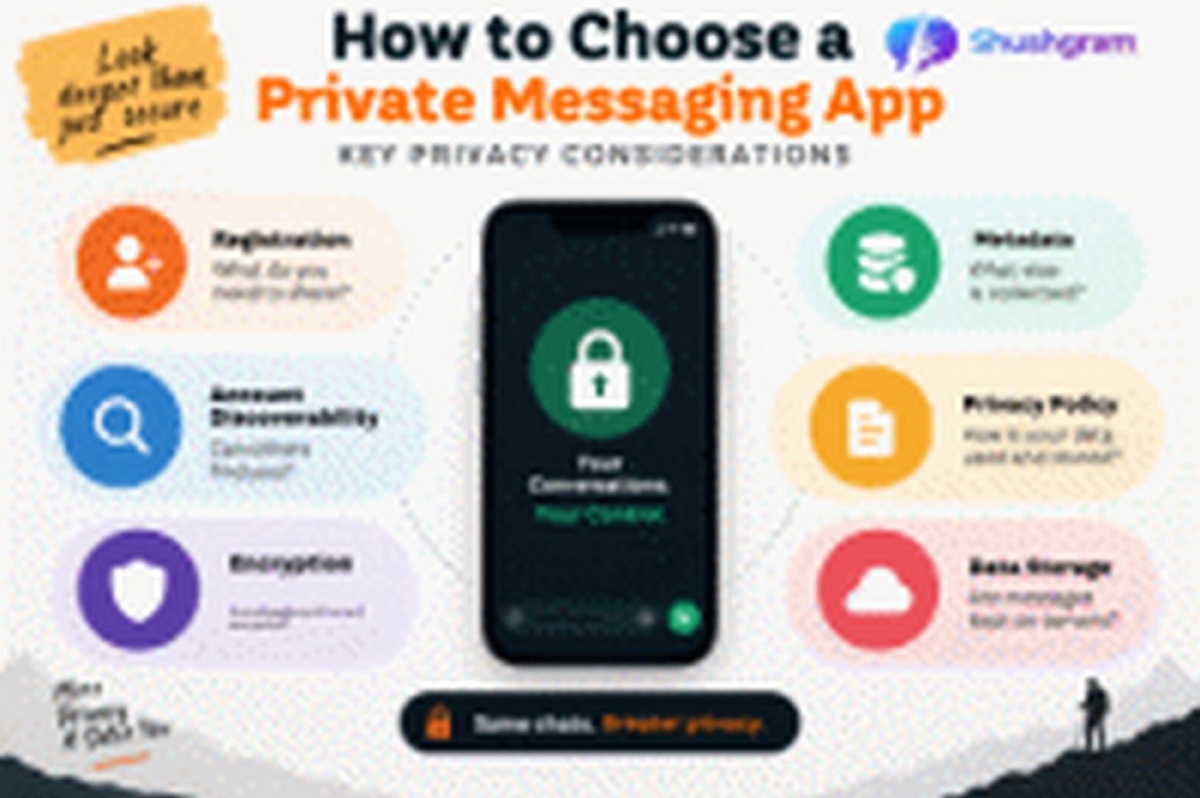
Your phone number might be used to identify your account. Your profile could be searchable. The service might collect IP addresses or device information. Messages may also remain stored on servers after you delete them from your phone.
That is why choosing a Private Messaging App requires more than checking whether an app says it is “secure.” You need to understand how it handles your identity, messages, metadata, storage, and account visibility.
Here are the privacy questions worth asking before you sign up for any Private Messaging App.
What does “private” actually mean?
Privacy, security, and anonymity are related, but they are not interchangeable.
A private messaging service should give you meaningful control over your conversations and the information other users can see. Security is about protecting information from unauthorized access. An Anonymous Messaging App goes further by reducing the connection between a user’s activity and their real-world identity.
But no single feature makes an app anonymous.
A service may not require your real name but still collect your IP address or device information. Another may require a phone number for registration but give you strong controls over whether other users can see or discover that number.
The details matter more than the label when evaluating any Private Messaging App or Anonymous Messaging App.
Start with registration
The registration process is one of the easiest ways to understand a platform’s privacy model.
Check whether the service requires a phone number, email address, real name, or another identifier. Also consider whether you have to give the app access to your contacts.
Phone numbers deserve particular attention because they are usually connected to an existing real-world identity. That does not automatically make phone-based registration a privacy problem, but it creates a different relationship between the user and the service.
Signal, for example, still requires a phone number to register. Its current privacy settings can prevent other users from finding you by that number, while an optional username can be shared to initiate a conversation instead. Signal is explicit that its username is not a permanent public handle or profile name.
There are also services taking a different approach. SimpleX says it does not assign users identifiers such as phone numbers, email addresses, or usernames. Instead, it uses temporary addresses for individual connections.
These models show why “does it use a phone number?” is only the starting point when choosing a Private Messaging App.
Can other people find your account?
Discoverability is easy to overlook when comparing Private Messaging Apps.
Some messaging services let people search for accounts using a phone number or username. Others require an exact username, invitation, or private link.
Look at what happens by default. Can someone who already has your phone number find you? Is there a public directory? Can you disable discovery? What information is visible when someone receives a message from you?
Signal, for example, does not provide a searchable directory of usernames. If a user disables discovery by phone number, someone generally needs the user’s exact username to initiate contact.
These details can make a real difference if you want to keep personal messaging separate from your public or professional identity.
Don’t stop at the word “encrypted”
Encryption is important, but the word itself does not tell you enough about a Private Messaging App.
Look for documentation explaining whether conversations use end-to-end encryption, which conversations are covered, and whether calls, groups, images, files, and backups receive the same protection.
Signal, for example, states that its conversations are end-to-end encrypted and that its client and server source code is publicly available.
Open-source code can be a useful trust signal because security researchers and other technically capable users can inspect it. Independent security audits can provide another useful signal. Neither should be treated as proof that a service is permanently secure, but both provide more evidence than a vague “military-grade encryption” claim.
What about metadata?
Protecting message content does not necessarily protect everything surrounding a conversation.
A service may still process information such as IP addresses, device details, timestamps, usage information, or information about how accounts interact.
So ask two questions:
-
Can someone read my messages?
-
What information can the service still learn about my communication?
The second question is often missed in privacy comparisons, but it can be just as relevant to someone trying to reduce their digital footprint when using a Private Messaging App or Anonymous Messaging App.
Read the privacy policy
The privacy policy is where marketing claims become testable.
Look for what information the service collects, why it collects it, whether it shares information with third parties, and how long it keeps different categories of data.
Data collection is not automatically a problem. A service may need certain technical information to operate accounts, maintain security, prevent abuse, or diagnose problems.
What matters is whether the collection is clearly explained and makes sense for the service.
For example, a platform that does not require a phone number can still collect an email address, IP address, device information, or usage data. Removing one identifier does not eliminate every privacy consideration when choosing a Private Messaging App.
Check storage and deletion
Deleting a conversation from your phone does not necessarily mean every copy has disappeared.
Before choosing a messaging service, check its retention policy. Find out whether messages are stored on servers, how long account information remains after deletion, and what happens to backups.
Disappearing messages can reduce the amount of conversation history that remains available, but they are not a guarantee that no copy exists. A recipient can still take a screenshot, save a file, or reproduce the content elsewhere. Server-side retention policies remain relevant too.
A trustworthy Private Messaging App should explain these limitations clearly.
Look at moderation as well
Privacy does not mean that a platform has no rules.
Messaging services still need ways to address harassment, threats, fraud, malicious activity, unauthorized access, and other forms of misuse.
This is particularly important for platforms with communities or group features. Check whether users can report abuse and whether the service explains what happens when its rules are broken.
Privacy and moderation address different problems. One protects legitimate communication; the other helps manage harmful or abusive activity.
Considering a Signal Alternative?
If you’re researching a Signal Alternative, compare specific privacy characteristics instead of asking which service is simply “more private.”
Signal, SimpleX, Shushgram, and other privacy-focused services use different approaches to identity and communication. Signal retains phone-number registration while offering phone-number privacy controls and usernames. SimpleX takes an identifier-free approach.
The right comparison depends on what matters to you. You might care most about end-to-end encryption, avoiding phone-number registration, limiting account discovery, keeping metadata to a minimum, or having private community features when looking for a Signal Alternative or Private Messaging App.
Where Shushgram fits
Shushgram can be considered alongside these different approaches as a Private Messaging App and potential Signal Alternative.
According to its current documentation, Shushgram does not require a phone number for registration. It uses usernames and private links for communication and does not provide a public user-discovery mechanism. Its website also describes private communities, temporary conversations, and end-to-end encryption.
At the same time, Shushgram’s privacy policy explains that the service may collect information such as email addresses, usernames, voluntarily submitted content, IP addresses, device information, and usage data.
That distinction is worth emphasizing. A service can avoid phone-number registration while still collecting other information necessary for its operation.
Shushgram’s Terms also establish rules covering harassment, threats, unauthorized access, malicious activity, and other prohibited uses. This is another reason to evaluate privacy and moderation separately rather than treating them as competing features when comparing any Private Messaging App or Signal Alternative.
Quick privacy check before you sign up
Before creating an account, take a few minutes to check how the messaging service handles the basics. Start with registration: what information does it require, and can you use the service without linking it to an existing identity?
Then look at discoverability. Can other people find your account through a phone number, username, or public directory? Check the encryption documentation as well. A clear explanation of end-to-end encryption is more useful than a general claim that messages are “secure.”
It is also worth checking what happens beyond the message itself. Does the service collect IP addresses, device information, usage data, or other metadata? How long is that information retained, and what happens when you delete your account?
Finally, consider how much control you have. Can you decide who contacts you or discovers your account? Is the technology open source or supported by independent security audits? And if something goes wrong, does the platform have clear rules and processes for handling abuse?
These questions cover the areas that matter most when evaluating a Private Messaging App or Anonymous Messaging App: registration, discoverability, encryption, metadata, data collection, retention, user controls, transparency, and moderation.
Choose based on your privacy requirements
There is no single privacy feature that makes a messaging app right for everyone.
If your main concern is message content, investigate the encryption model. If you want to keep your personal identity separate from your account, examine registration and username requirements. If you do not want strangers finding you, study account discovery and profile visibility.
It is also worth considering the trade-offs. Services that avoid phone-number registration may reduce the amount of personal information connected to an account, but they may use different methods for account recovery, spam prevention, or abuse management.
Whether you’re choosing a Private Messaging App, looking for an Anonymous Messaging App, or comparing a Signal Alternative, start with your own privacy requirements and then examine the documented features and policies of each service.
That approach makes the decision much clearer. Instead of asking which app sounds private, you can see exactly what each platform protects, what it collects, and what it asks you to trade in return.